
Ever wondered how pubs get their names? Well, here’s a selection of explanations for you… They are true to the best of my knowledge, though you probably shouldn’t go to court off the back of them.
Red Lion – Right up there as one of the most popular pub names in Britain, its origin lies in the 14th century potentate John of Gaunt, on whose coat of arms it appeared. It really hit the top of the charts when James VI of Scotland kindly agreed to be King of England as well. In those days Kings had more than ceremonial power, and he decreed that the Red Lion (also on his coat of arms) be displayed all over the place. It was a kind of “Nyer nyer nyer, the Scots are in charge” vibe. However, since he was King, many innkeepers thought it might be wise to humour him, and the Red Lion appeared outside taverns the length and breadth of the country.
Swan With Two Necks – There are a few of these about. It is a staple of pub quizzes that Swans have traditionally been the property of the reigning Monarch. However, in the 16th century, good Queen Bess thought it would be nice to let someone else have some swans. She granted such a right to the Worshipful Company of Vintners. In order to be able to tell which Swan belonged to whom, it was decided that Vintners’ swans should have their beaks marked with two notches, or nicks. Now, in those days, ‘neck’ was another form of ‘nick’ and so the ever witty Vintners spotted that a Swan With Two Necks could afford them a rather clever pun, and so signs outside Vintners’ taverns began to show Swans with two necks (and heads, otherwise it would look weird). Hence ‘The Swan With Two Necks’.
Bear & Ragged/Rugged Staff – Oftentimes, Inn names sought to reflect the Innkeeper’s loyalty to the local landowners or ruling gentry. In this instance, The Bear & Ragged Staff is a heraldic sign aimed at showing loyalty to the Earls of Warwick. In fact, I believe it appears on Warwickshire County Cricket Club’s badge to this day.
Marquis of Granby – Now here was a thoroughly good chap. In the eighteenth century he was a top dog in the English Army, usually giving the French a good cuff around the ear. However, as laudable as some may consider fighting Frenchmen to be, his greater legacy was that, when many of his officers left the Army in time of peace, he would set them up with a nice little living as a tavern keeper. Understandably grateful, and knowing when they were on to a good thing, the tavern keepers registered their gratitude by naming their pub after him.
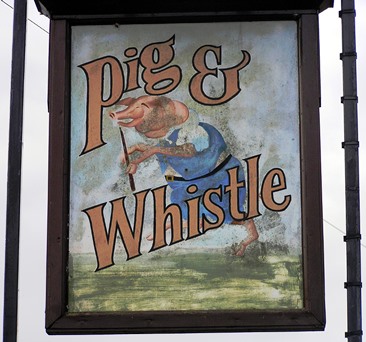
Pig & Whistle
Pig & Whistle – This name seems like one of those modern Newt & Cucumber or Kebab & Calculator type names, but actually it goes much further back. The phrase ‘Pigs and Whistles’ dates back over 300 years, and means ‘Rack and ruin’. Since successive generations have unfairly held that frequent visits to pubs were tantamount to self-ruination, to go to the pub might be to ‘Go to Pig(s) & Whistles. Again, an average pun, but one which made for some very pretty pub signs.
Lammastide – I only know of one of these – a lovely pub in Gloucestershire – and rural people will not need to be told what it means. However, I came from the city so find the origin fascinating. Lammastide is a corruption of Loaf Mass Tide. The Loaf Mass was a religious ceremony to bless the first bread of the year, which was made from the first corn to ripen towards the end of the summer. So, Lammastide was the time of the year when this ceremony took place, which eventually entered the calendar as August 1st.

Lammastide
Rose & Crown – As you may imagine, any pub with a Crown in its name represents a sign of loyalty to the Monarchy. In this instance, however, there was a little mischief behind it. The Rose is England’s flower, of course, and these signs are first recorded in the 17th century, not long after James VI of Scotland was encouraging Red Lions all over the place. The Rose & Crown was a way for English inn keepers to quietly say “OK, we’re loyal to the King (I mean, we’re not stupid), but let’s not forget we’re English”.
Crown & Anchor – OK, so we’re OK with the Crown part, right? Anchor? Well, that would suggest sailors and the like. So, the Crown and Anchor is for Sailors loyal to the Monarch? Spot on, the Crown & Anchor appear on the coat of arms of the Lord High Admiral and, for retired Naval Officers who set up taverns, was a nice way of showing their nautical roots and remembering those carefree days being keel-hauled and dunked in barrels.
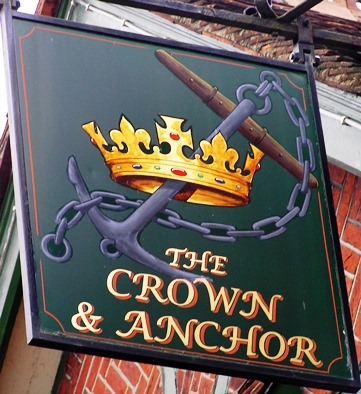
The Crown & Anchor
Crooked Billet – It is a popular misconception that pub signs came along to illustrate the name of the pub, when actually it was the other way around. In ancient Roman times, taverna keepers would hang out a bunch of grapes to show locals that the harvest was in. Much later, english taverns also wanted a way to draw attention to themselves, so they would hang something outside as a sort of reference point for travellers. One of the most primitive and simple of which was a Crooked Billet (a billet was a big old stick fallen from a tree), so that medieval travellers’ could be told: “If thee travelleth west from London toward that fair town of Bracknell. Thou shalt after a few hours come across an inn with a crooked billet outside, and there wilt thou be made most welcome, before continuing thy journey to the Siemens Computers Head Quarters”. Or something.
Rising Sun – In the 60s, there was a popular group called the Animals…. OK, that’s not it really. Actually, it is heraldic again. Edward III, William II and William III all had it on their coat of Arms. The Sun Rising suggesting a new dawn, and a bright future.
It was also jolly easy to draw on a sign.
White Hart – Well, this one is a combination if Heraldry and History. The White Hart was on Richard II’s coat of arms and, let’s hope his widow doesn’t sue me, he was a belligerent and aggressive sort of chap. An innkeeper who displayed this sign was saying… “Don’t burn my pub down, I’m on your side”. Such was the level of toadying at this time, that the name White Hart became synonymous with pubs, and people continued using it longer after Richard II was gone.
Green Dragon – Although the Dragon slain by St George was actually Green (although it became more red as the battle progressed) a Green Dragon on its own is actually another Heraldic symbol. This one has Welsh origin, and represented loyalty to the Earls of Pembroke. Heraldically, the Green Dragon is more welsh than the Red Dragon, which appears on the principality’s flag.
Spread Eagle – Not, as I’m sure you’ve guessed, a particularly British symbol, but a useful illustration of why some British pubs have distinctly non-British wildlife on them. Coats of Arms were actually a dynamic and changing thing. When a House had won a war, or conquered somewhere, or slaughtered a load of foreigners in the name of Christianity, the symbols of the defeated would often be incorporated into the coat of arms of the winners to commemorate the victory. The Spread Eagle was heraldically important across Europe and all the way back to Ancient Rome. Its appearance in British taverns commemorates those ‘Houses’ which beat them, and nicked their badge.
Fawcett Inn – Not all pub names are old and Heraldic. The Fawcett Inn is a pun. Force It In, geddit?? There’s also a Dew Drop Inn…
There, that’ll do for now, but I’ll do some more when I get round to it. Tell you what. If there are any names you would like to know more about, email pintsbristol at yahoo dot co dot uk, or…


 pintsbristol